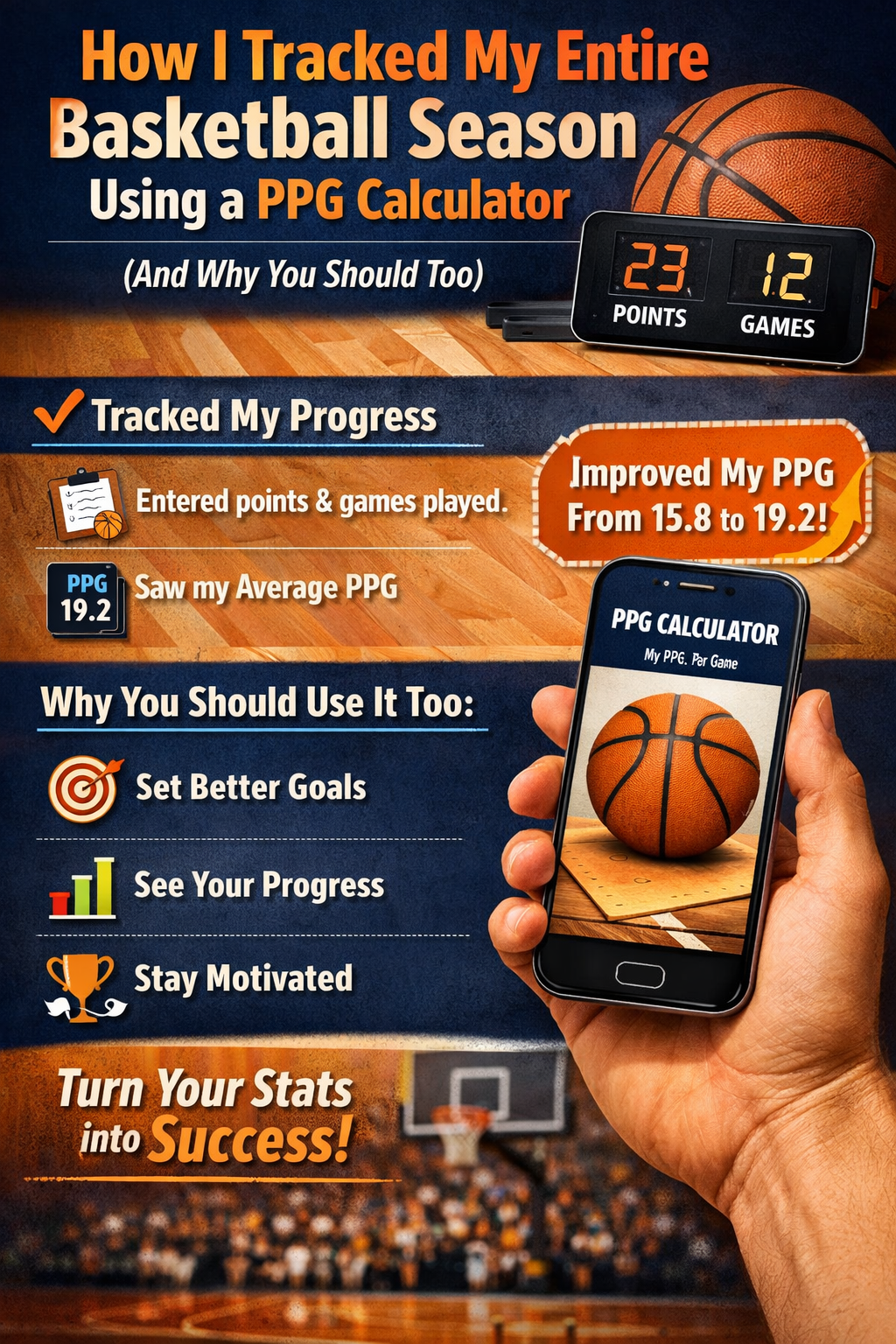
I never thought I’d become that guy—you know, the one obsessively tracking basketball stats on their phone during halftime, creating spreadsheets at 11 PM after games, and texting screenshots to teammates with analysis nobody asked for.
But here I am, three months into my rec league season, and honestly? This might be the best thing I’ve done for my game in years.
Let me tell you the story of how a simple PPG calculator changed the way I approach basketball, and more importantly, how it helped me actually get better instead of just thinking I was getting better.
The Wake-Up Call (Week 1)
It started with trash talk, as most good stories do.
We’d just finished our second game of the season. I dropped 28 points—my highest in years—and I was feeling myself. In the group chat, I declared I was “easily averaging 25+ this season.”
My buddy Chris, who has a memory like a steel trap and the personality of a fact-checker, immediately called me out:
“Bro you scored 16 in the first game. That’s 22 PPG. Not 25.”
I was convinced he was wrong. I pulled up my mental notes (which, let’s be honest, are wildly unreliable), and realized… I had no idea. I genuinely couldn’t remember my game one score with certainty.
That’s when it hit me: If I’m serious about improving, I need actual data. Not vibes. Not “I felt like I had a good game.” Real numbers.
Setting Up My Tracking System (Week 1, Take Two)
That night, I did what any self-respecting millennial would do: I fell down a rabbit hole of basketball stat tracking.
I looked at apps (too complicated), considered buying a stats journal (who uses paper anymore?), and almost signed up for a paid analytics platform (way too expensive for a rec league player in his 30s).
Then I found a simple PPG calculator online and had an epiphany: I don’t need all the bells and whistles. I just need to track the basics consistently.
Here’s the dead-simple system I created:
My Tracking Tools
1. Google Keep Note (For Game-Day Tracking)
- Quick to open during games
- Syncs across my devices
- Simple bullet points work perfectly
2. Google Sheets (For Season Overview)
- One row per game
- Columns: Date, Opponent, Points, FG Attempts, Minutes Played, Notes
- PPG formula that auto-calculates:
=SUM(C2:C20)/COUNTA(C2:C20)
3. PPG Calculator (For Quick Checks)
- Used after each game for instant gratification
- Bookmark saved on my phone’s home screen
- Takes literally 10 seconds
What I Track (And Why)
I started simple and only added complexity when I noticed patterns:
Must-Track Stats:
- Points scored (obviously)
- Games played
- Current PPG
Nice-to-Have Stats (Added Later):
- Shot attempts (to track efficiency)
- Minutes played (some games we blow teams out and I sit the 4th quarter)
- Game location (I discovered I score 4 more PPG at our home court)
- How I felt (energy level, injuries, etc.)
Don’t-Bother Stats:
- Rebounds and assists (my teammates track these if they want)
- Plus/minus (too complicated for rec league)
- Advanced metrics (we’re not the NBA)
The First Month: Reality Hits Different
Game 3 (Week 2): The Efficiency Check
19 points on 24 shot attempts.
I calculated my PPG: 21 PPG through 3 games. Not bad! But when I looked at the shooting percentage (19/24 = 79%… wait, that can’t be right. I meant 19 points on 24 attempts, not 19 made shots), I realized I shot something like 8-for-24.
That’s 33% shooting. Ouch.
This is where the tracking got real. I was getting my points, but I was also taking a TON of shots to get there. My teammates didn’t say anything (they’re nice like that), but the data didn’t lie.
Lesson learned: PPG without context is meaningless. I added “FG Attempts” to my tracking that night.
Game 5 (Week 3): The Consistency Problem
Here’s what my first five games looked like:
- Game 1: 16 points
- Game 2: 28 points
- Game 3: 19 points
- Game 4: 12 points
- Game 5: 30 points
Current PPG: 21.0
See the problem? I was a rollercoaster. One game I’m Steph Curry, next game I’m a bench warmer having an off night.
I started adding notes after each game:
- Game 2 (28 pts): “Felt great, legs were fresh, hit my midrange”
- Game 4 (12 pts): “Tired from work, legs heavy, rushed shots”
Patterns started emerging. My bad games weren’t random—they happened after stressful work weeks or when I skipped my pre-game warmup.
Lesson learned: Consistency matters more than ceiling. I’d rather be steady at 18 PPG than swing between 12 and 30.
Mid-Season: Making Adjustments (Weeks 6-10)
By week 6, I had enough data to actually make changes. This is where tracking became coaching.
Discovery #1: First Quarter Struggles
I noticed something weird: I averaged just 2.8 points in first quarters, but 6.4 points in third quarters.
Why?
I reviewed my notes: “Cold start, forcing shots, trying to do too much early.”
The fix: I stopped trying to score in the first 5 minutes. Instead, I focused on defense and passing, let the game come to me, and started attacking in the second quarter once I found my rhythm.
Result? My PPG actually went up because I took better shots.
Discovery #2: The Home Court Advantage
Check this out:
- Home games: 24.3 PPG (7 games)
- Away games: 17.1 PPG (6 games)
That’s a 7-point difference! At first, I thought it was competition level, but the teams were similar.
Then I realized: Our home court has a different depth perception. The rims are slightly older, the lighting is brighter, and I’m just more comfortable there because we practice on that court.
The fix: I started showing up 20 minutes early to away games to get shots up and adjust to the rim.
Discovery #3: The “Hero Ball” Trap
Here’s an embarrassing one. In games where we were losing at halftime, my scoring average was 26.4 PPG. In games we were winning? Just 18.7 PPG.
My initial thought: “I’m clutch! I step up when my team needs me!”
Chris’s observation (because he’s insufferable): “Or you’re shooting us out of close games and getting carried in blowouts.”
I checked the win/loss record. We were 3-4 in games where I scored 25+ points, but 6-2 in games where I scored 18-22 points.
Turns out, when I try to “take over,” I jack up bad shots and disrupt our flow. When I play within the offense, we win.
The fix: I set a personal rule: No more than 15 shot attempts per game unless we’re down double digits in the 4th quarter. If I’m scoring efficiently, great. If not, I pass more.
This was the hardest adjustment because it meant sacrificing PPG for wins. But that’s the point, right?
The Excel Spreadsheet That Changed Everything
Around week 8, I got bored one Sunday and built out my tracking spreadsheet into something actually useful.
Here’s what I included:
The Dashboard (Overview Tab)
Current Season Stats:
Games Played: 15
Total Points: 312
Current PPG: 20.8
Highest Game: 32 pts (vs. The Rejects)
Lowest Game: 12 pts (vs. Ball Hogz)
Shooting %: 47.2% (calculated from total makes/attempts)
Trend Indicators:
- Last 5 games PPG: 22.4 (↑ trending up)
- Home vs Away differential: +7.2 home
- Win % when scoring 20+: 71%
Game Log (Detail Tab)
| Date | Opponent | PTS | FGA | FG% | MIN | PPG | Notes |
|---|---|---|---|---|---|---|---|
| 10/15 | Ballers | 16 | 18 | 44% | 32 | 16.0 | Rusty, first game |
| 10/22 | Legends | 28 | 23 | 52% | 36 | 22.0 | Hot shooting night |
| 10/29 | Grinders | 19 | 21 | 43% | 28 | 21.0 | Solid, got tired |
The Visualization (My Favorite Part)
I created a simple line graph showing my PPG over time. Watching that line trend upward was more motivating than any pregame speech.
I also added a bar chart comparing my points by quarter, which revealed my first-quarter struggles I mentioned earlier.
Pro tip: If you’re not into Excel, even a piece of graph paper works. The visual representation is what matters.
Late Season: Chasing Milestones (Weeks 11-15)
With 5 games left, I was sitting at 19.8 PPG. So close to that 20 PPG threshold.
Normally, I would’ve started forcing shots to get there. But the tracking had taught me something: empty stats feel empty.
Instead, I set a different goal: Maintain my efficiency while getting to 20 PPG.
Game 16: The Mental Battle
17 points on 11 shot attempts. Not my highest scoring game, but 55% shooting—one of my best efficiency nights.
My PPG dropped to 19.6. I was briefly annoyed, then realized: We won by 18, I played great defense, and I got my teammates involved.
The old me would’ve been upset. The data-tracking me understood the bigger picture.
Games 17-18: Finding Balance
I scored 24 and 22 in the next two games, both on efficient shooting. My PPG climbed to 20.1.
But here’s what I’m most proud of: I tracked my shot selection, and I was taking 68% of my shots in the paint or from my favorite midrange spots. Only 32% were “bad” shots (contested threes, off-balance jumpers).
Three months earlier? That ratio was probably flipped.
Game 19: The Test
We played the best team in the league. I scored 18 points on 45% shooting. We lost, but I passed the eye test and the stat test.
After the game, their coach (who’s coached college ball) told me I was the most improved player he’d seen all season.
That compliment meant more than any scoring title.
End of Season: The Results
Final stats after 20 games:
Overall Numbers:
- Total Points: 416
- Games Played: 20
- Final PPG: 20.8
- Shooting %: 48.1%
- Team Record: 13-7
Month-by-Month Progression:
- October (Games 1-5): 21.0 PPG, 41.2% shooting
- November (Games 6-12): 19.7 PPG, 47.8% shooting
- December (Games 13-20): 22.1 PPG, 52.4% shooting
Key Insights:
- Scored 20+ points in 11/20 games (55%)
- Team was 9-2 in games I scored 18-24 points
- Shot 51.2% in wins vs. 42.1% in losses
- Home/Away gap narrowed from 7.2 PPG to 4.1 PPG
What I Learned About Tracking (Beyond Basketball)
1. Data Reveals Blind Spots
I thought I was a good shooter. Data said I was average. I thought I was consistent. Data said I was erratic.
Neither of these were fun to learn, but both made me better.
2. What Gets Measured Gets Improved
The simple act of tracking made me more conscious during games. I’d think, “I’m 3-for-9 right now, maybe I should pass more” instead of just chucking up another shot.
3. Context Is Everything
A 15-point game where you shoot 7-for-10 is better than a 25-point game where you shoot 9-for-28. The PPG calculator gives you the number, but you need the context to understand it.
4. Trends Matter More Than Single Games
I had some terrible games (including an 8-point stinker in week 12), but the overall trend was positive. One bad game doesn’t define your season.
5. Tracking Makes You Honest
You can’t lie to yourself when the numbers are right there. I was forcing shots early season. I was inconsistent. I had defensive lapses. The data forced me to confront these issues.
My Tracking System: The Final Version
By season’s end, here’s what my process looked like:
During the Game:
- Mental note of points after each quarter
- Quick tally on my phone during timeouts
Immediately After:
- Open PPG calculator on my phone
- Enter total points and update game count
- Screenshot the result for my records
That Night:
- Update my Google Sheet
- Add notes about shot selection, energy level, etc.
- Review running PPG and trends
Weekly:
- Look at 5-game rolling average
- Identify patterns (good and bad)
- Set one focus area for next game
Total time invested: Maybe 5 minutes per game, 15 minutes per week for review.
Total benefit: Impossible to quantify, but massive.
Mistakes I Made (So You Don’t Have To)
Mistake #1: Tracking Too Much Too Soon
My first spreadsheet had 15 columns. I tracked rebounds, assists, steals, blocks, turnovers, plus/minus, and a bunch of other stuff.
I lasted three games before I gave up because it was too much work.
Lesson: Start simple. Points and games played. That’s it. Add complexity only when needed.
Mistake #2: Obsessing Over One Stat
Around week 6, I was so focused on PPG that I stopped playing defense. My coach called me out, and rightfully so.
Lesson: PPG is one metric. Winning matters more.
Mistake #3: Not Backing Up My Data
My phone died in week 9, and I hadn’t backed up my notes. I lost three games worth of detailed observations.
Lesson: Use cloud-based tools (Google Sheets, cloud notes, etc.). Auto-sync is your friend.
Mistake #4: Comparing to Others
I saw a guy in another league averaging 27 PPG and felt inadequate at 19 PPG. Then I realized he plays in a lower division and takes 30 shots per game.
Lesson: Compare yourself to yourself. Track your improvement, not your rank.
Mistake #5: Forgetting the Fun
There was a stretch where I was so focused on stats that I forgot to enjoy playing. Basketball is supposed to be fun.
Lesson: Data is a tool, not the goal. Use it to improve, but don’t let it suck the joy out of the game.
Tools & Resources I Actually Used
Here’s my honest assessment of what worked:
Must-Haves:
- ⭐⭐⭐⭐⭐ Google Sheets – Free, simple, accessible everywhere
- ⭐⭐⭐⭐⭐ Online PPG Calculator – Instant calculations, bookmark-worthy
- ⭐⭐⭐⭐⭐ Phone Notes App – For quick game-day tracking
Nice-to-Haves:
- ⭐⭐⭐⭐ Excel – If you want fancier visualizations
- ⭐⭐⭐ Physical Notebook – Old school but satisfying
Didn’t Need:
- ⭐⭐ Paid Stat Apps – Overkill for rec league
- ⭐ Wearable Trackers – Interesting data, but didn’t improve my game
The Unexpected Benefits
Beyond the basketball improvements, tracking had some surprising effects:
1. Better Focus
Knowing I was tracking made me lock in during games. No mental lapses because I knew I’d see them in the data later.
2. Team Credibility
When I could back up observations with numbers (“I’m shooting 52% from midrange this month”), teammates actually listened to my suggestions.
3. Motivation Through Slumps
When I had a terrible game, I could look at my season trend and see I was still improving overall. That kept me from spiraling.
4. Conversation Starter
Other players started asking about my system. Two teammates now track their stats, and we compare notes after games.
5. Accountability
Hard to make excuses when the data is right there. If I’m shooting poorly, I need to adjust, not blame the refs.
Would I Do It Again? Absolutely.
Next season starts in February, and I’m already planning my tracking system upgrades:
What I’m Adding:
- Shot chart (track where I’m taking shots from)
- +/- per quarter (when does our team perform best with me on court?)
- Pre-game routine tracking (does my warmup affect performance?)
What I’m Keeping:
- Core PPG tracking (it’s simple and effective)
- Post-game notes (context is crucial)
- Weekly review sessions (reflection drives improvement)
What I’m Dropping:
- Nothing, honestly. The system is lean enough that everything serves a purpose.
Your Turn: Getting Started
If you’re thinking about tracking your season, here’s my advice:
Week 1:
Just track points and games. Get comfortable with the PPG calculator. That’s it.
Week 2-4:
Add one more stat that interests you (shot attempts, minutes, etc.). See if it reveals anything useful.
Week 5+:
Build your system based on what you’ve learned. Everyone’s different. What matters to me might not matter to you.
The Golden Rule:
If tracking ever feels like a chore, you’re doing too much. Simplify. The goal is improvement, not creating work.
Final Thoughts
Here’s the truth: I’m a 32-year-old playing in a recreational basketball league. Nobody’s scouting me. There’s no scholarship on the line. This is just for fun.
But tracking my PPG turned “just for fun” into “fun with purpose.” It gave me goals to chase, improvements to celebrate, and honest feedback when I needed it.
I started this season thinking I was a 25 PPG player. Data showed me I was a 16 PPG player with potential. By season’s end, I was a legit 20 PPG player with efficiency.
More importantly, I’m a smarter player. I take better shots. I understand my tendencies. I know when to attack and when to facilitate.
All from a simple calculator and 5 minutes of tracking per game.
If you’re even slightly curious about tracking your stats, just try it for 5 games. That’s all. Five games of writing down your points and calculating PPG.
I bet you’ll learn something about your game.
And I bet you won’t stop after five games.
Have you tracked your basketball stats before? What did you learn? Drop a comment below—I’d love to hear about your experience or answer any questions about my system.
Ready to start tracking? check our PPG Calculator – Bookmark this and use it after your next game. Then come back and tell me what you discovered.